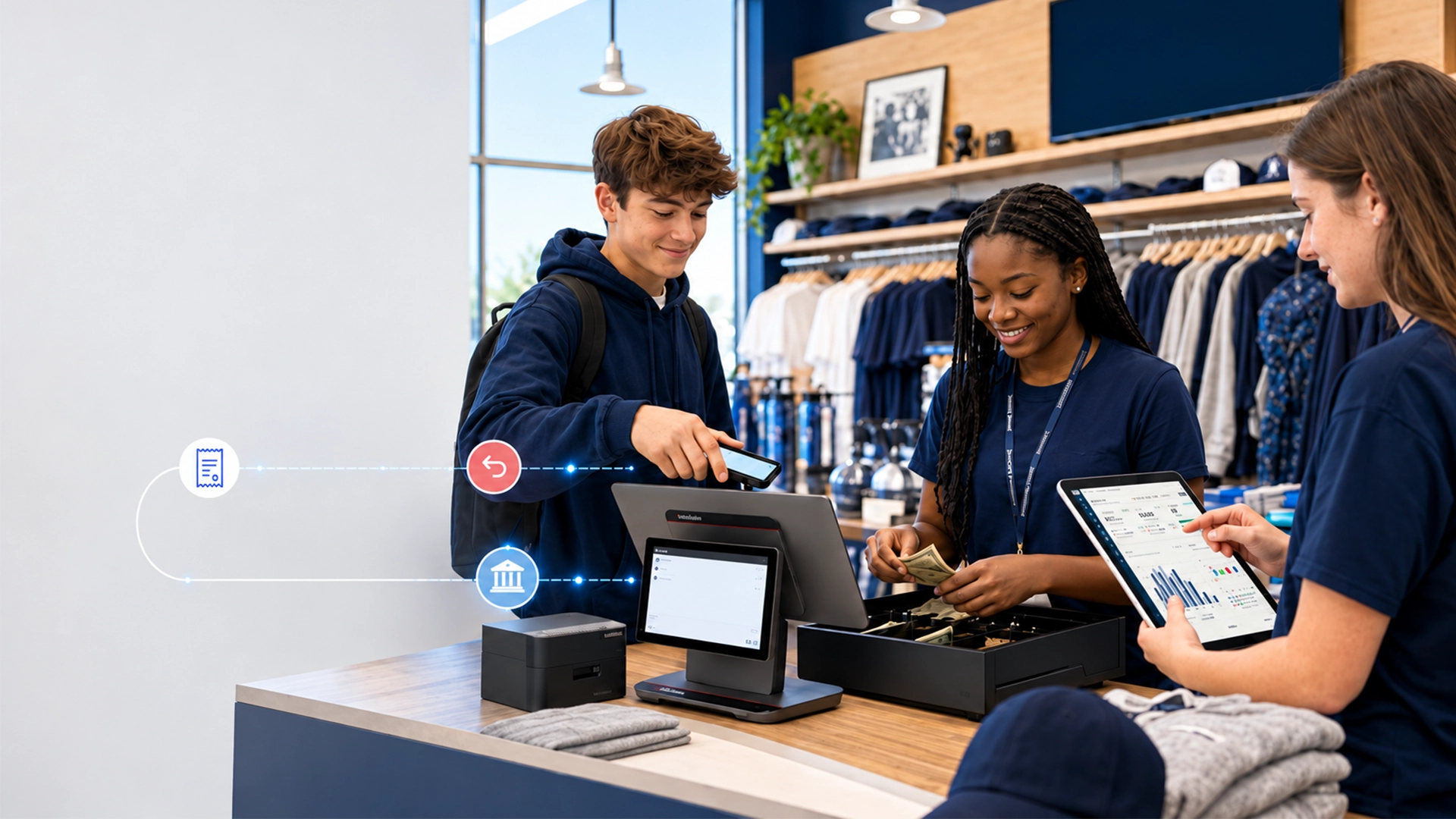
The way consumers pay has changed.
Customers expect to pay by card or digital wallet, whether they’re shopping at a major retailer, a local coffee shop or a school-based enterprise. For students learning how modern businesses operate, understanding digital payments should be part of the experience.
But accepting cards isn’t just about convenience. It changes how a business tracks money, reconciles transactions and creates accountability around every dollar.
For an SBE, those are valuable lessons.
Cash and Card Are Fundamentally Different
With cash, a student accepts money, provides change and places the cash in a drawer. At the end of the day, someone counts the drawer and compares it against recorded sales.
Digital payments add another layer. Each transaction creates a record: how much was charged, when it occurred, whether it was refunded and how the money ultimately reaches the bank.
Students can begin asking:
- How much did we collect in cash versus card?
- Do our transactions match our sales?
- Does the cash drawer match what should be there?
- Were any transactions refunded?
- How much should be deposited?
- Can we account for every dollar collected?
These aren’t just payment questions. They’re fundamental business controls.
Every Transaction Should Have a Trail
One of the most important lessons an SBE can teach is that businesses don’t simply collect money. They account for it.
Students can reconcile sales against cash collected and digital transactions processed. When something doesn’t match, they can identify the discrepancy and understand why it occurred.
Maybe a transaction was entered incorrectly. Maybe a refund was issued. Maybe the cash drawer is short or over.
The lesson isn’t that discrepancies never happen. It’s that well-run businesses have processes to identify, document and resolve them.
Understanding the Daily Close
The end of each business day provides an opportunity to teach financial responsibility.
If an SBE generates $1,000 in sales, students should understand exactly how that money is accounted for. Perhaps $250 was collected in cash and $750 digitally. Students can verify the drawer, review digital transactions and understand what amount should ultimately reach the bank.
This turns closing the register into a basic financial reconciliation.
It also introduces an important concept: the number on a sales report, the cash in the drawer and the money deposited into the bank are connected, but they aren’t necessarily the same thing.
Accountability Matters
Modern payment systems also introduce students to an important business principle: who did what?
Who processed the transaction? Who issued the refund? Who closed the drawer? What was the expected cash total? What was actually counted?
Clear records create accountability and transparency. Students learn that financial controls aren’t about assuming someone did something wrong. They’re about making financial activity understandable and verifiable.
Preparing Students for Modern Business
There is still educational value in handling cash. Students should understand how to count a drawer, make change and reconcile physical money.
But they also need experience with the payment environment they’ll encounter outside the classroom.
The opportunity for an SBE isn’t simply to go cashless. It’s to use modern payments to teach students how money actually moves through a business.
Every dollar should be accounted for, every transaction should have a trail, and every business should be able to explain how money moved from the customer to the bank.